
Firstly, I’ve discovered a new word: botshit. It’s a more visceral description of AI Slop that’s been generated without sufficient oversight from common sense. And I just had to share. Also, it’s cited in an actual academic paper – endorsed by academics, so feel free to use it with impunity.
Secondly, I wanted to talk about using AI to subtract rather than add, because it might be the most important starting place to swerve botshit.
The default instinct is to add AI to existing processes. Run the same reports faster. Automate the same checks. Operate the mess for less. That’s a valid short-term benefit, but the real value comes from asking a different question entirely: “How might we rethink how we do this?” Not “how can we use AI to do what we do today more efficiently?”
AI’s ability to create coherence from vast volumes of unstructured data, and to be orchestrated with other systems, means that the need to remove waste in all its forms may no longer be necessary. The constraint has changed. The process design should change too.
Easy for me to say. Harder to do. Why? As it needs a combination of imagination and logical systems thinking. But it’s also the magic behind many category defining technologies.
For example, in the early days of the internet, people were looking for dates and happy to hand over their credit card details to some tech bros in order to find a match (or should that be a match.com). Surprising in itself. To improve the dating experience, match.com then added more features: questionnaires, algorithms, premium subscriptions. Until Tinder came along and subtracted all of that, shortlisting by location and reducing the friction of searching to a simple swipe.
Similarly recruitment has operated with the ATS (Applicant tracking system). Rather than reading all the CVs as a sisyphean task, recruiters used key word searches. Everyone knew it binned good people on a missing word. The default instinct was to make the filter smarter. The rethink: AI can genuinely read all 800 applications and reason across them, so you don’t tune the filters, you delete them. The constraint (“a human can’t read 800 CVs”) is gone.
However, it’s not always easy. Even Open AI is not following my advice. They sent me an email yesterday suggesting that we use ChatGPT to research products:
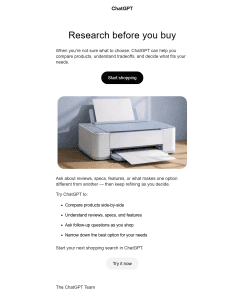
I mean, sure, you can just swap your allegiance from Googling to ChatGPTing. But it doesn’t follow my subtract don’t add principle. Using ChatGPT to research products is a faster horse, not a car. Or to coin a phrase: faster botshit is still botshit.
Subtraction asks why are you researching at all? I don’t want to research a toaster. I want a good toaster to arrive. Research is the friction, not the job. My guess is that they see this as an easy sell to lure you towards their “Buy it now” button and attract you into agentic commerce.
Perhaps the agent that buys for you is the ultimate subtraction. But it could be the ultimate botshit risk. Because the botshittery is entirely dependent on the oversight behind agentic commerce. The judgement comes in the design of the agent set-up and specifying the goal of what good looks like, reputable sources of insight and vetting suppliers. There’s more to it than trusting the machine.
Before you let AI do something faster, ask what you’d delete if you were brave. Then ask what judgement has to survive the deletion. The first question is the fun one. The second is the hard part.
Want to know more about AI strategy, read this next.
This essay first went to subscribers of The Hard Part, my weekly newsletter. The Hard Part about adopting new digital tools and AI is almost never the technology, it’s changing the way people work. Never more than a 5 minute read: helen-dawson.kit.com/the-hard-part