
My friend Sandie who’s a kick-ass copywriter asks, “If you are Harry Potter, who is Voldemort?”
And I’ve decided that my Voldemort is people selling AI training and AI pilots that are unlikely to deliver the promised value.
Don’t get me wrong. I can 100% see why “Let’s buy Copilot and let’s train everyone on it!” is logical and hard to criticise. But here I am criticising it.
Why’s Traditional Tech Change Management my Voldemort?
Because I think that’s a very outdated approach to technology deployment. Let’s face it we’ve all done training courses where you click through screen after screen online whilst multi-tasking in a Teams channel. Or we’ve taken a day/ half day in a conference room, where it’s felt like a sheep-dip. All sensible stuff on the technology but abstract and difficult to translate into the day job. It’s all very well making a high protein meal plan (why is that always the use case??) but that’s not going to help you if you’re trying to figure out complex pricing or manage large scale tenders.
There’s also a tendency with AI tools to tell people to just play around. I’ve heard someone say “No use case is too small!” in the open plan. Which is fine if you’re playing around with a chatbot in your personal life. But not a solid way of capturing enterprise wide ROI.
It also ignores a fundamental feature of organisations: work is done in teams and moves between different people.
The “no use case too small” brigade inadvertently are championing people finding individual productivity hacks. There can still be good stuff here but it’s unlikely to ladder up into enterprise-wide AI-first transformation (or whatever word salad was put in the board paper).
What’s the alternative?
Context is everything. Knowing how your industry works and how your business works is important in making AI tools that give you competitive advantage. Which is why the concept of forward deployed engineers are the Dementors to my Voldemort. A bright person who knows the tech isn’t going to be the catalyst you need. The person you need understands the current pain and understands how to navigate the organisation to improve things.
So, yes, I do teach people how to work with AI. But it’s not sheep-dip training. It’s hackathon style. Hands on, on their own work, solving a challenge as a team.
Learning by doing beats being taught prompt engineering. And that’s even more true now the generally available AI tools have become more capable. You can moan about a problem in every day language and then ask “help me fix it.”
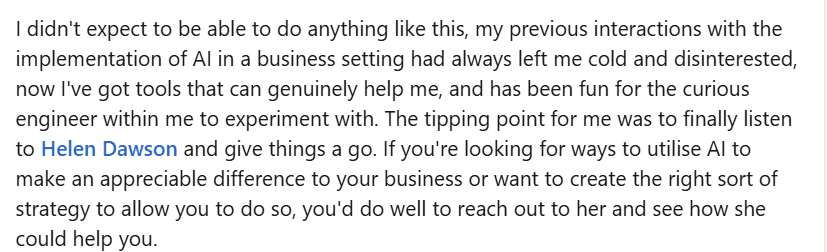
And it makes for a far more effective use case discovery exercise once people have the confidence to do more with those AI tools. It then becomes a gateway drug into more sophisticated agentic AI or Physics-based AI.
Don’t I need an AI strategy though?
Yes, you need strategy but I don’t think that is necessarily a stand-alone AI strategy.
Two things your strategy work needs to look at IMHO:
- It’s better to think only of the business strategy and then use AI as a tactic to contribute to that. Otherwise, you’re in AI-First-Land which could mean anything to anyone.
- Picking one or two themes to focus AI efforts on is a good way to get focus and traction. And no, productivity isn’t a theme. But “improving the tender process” is. And you’ll note that I haven’t even written that as a S.M.A.R.T. goal – because that’s the job of the team working on it to define what good looks like and the crawl-walk-run approach to moving towards good.
Personal opinion: You need decision makers to understand enough to steer it. And it helps you better target opportunities if you’re tied into strategy. So, whether you start with strategy or start with adoption, there’s some upskilling that needs to happen.
Similarly, buying an AI pilot is tempting. But without the strategic thinking, you’re hoping that a vendor will pick a use case that matters to you. And you’re hoping that your team is AI-aware enough to govern it.
There are only seven working weeks of 2026 left. Give me a shout if you want to start 2027 with less sheep dip training and more clarity.
Three ways to work with me:
- Hands on training for decision makers so they can lead and govern AI
- Hackathons for teams to make prototypes by home time
- Strategy work to understand how might AI disrupt your business, map the tactics and make a plan
Want to know more? Book a call: https://calendly.com/helen-dawson/discovery-call
Until next time,
Helen
P.S. Smart AI powered buildings that read the room? Listen to an amazing conversation with the Co-founder of Envelo whose business does just that. The Innovation Crowd Podcast.