
1997 at the V festival in Leeds, the Stereophonics were on the NME stage at lunchtime. We’d just arrived in the arena. I listened for a couple of minutes. Said “They sound good.”
I could have been an early adopter but I swerved right to go to the beer tent.
With AI, I haven’t made the same mistake. Back in 2018, my team were exploring the use of machine learning and machine vision to improve operations and customer experience in petrol stations. Eight years on and there’s a plethora of new AI tooling and capabilities. I did not trot off to the metaphorical beer tent. And I’m on a mission for people to spend their AI budget more fruitfully.
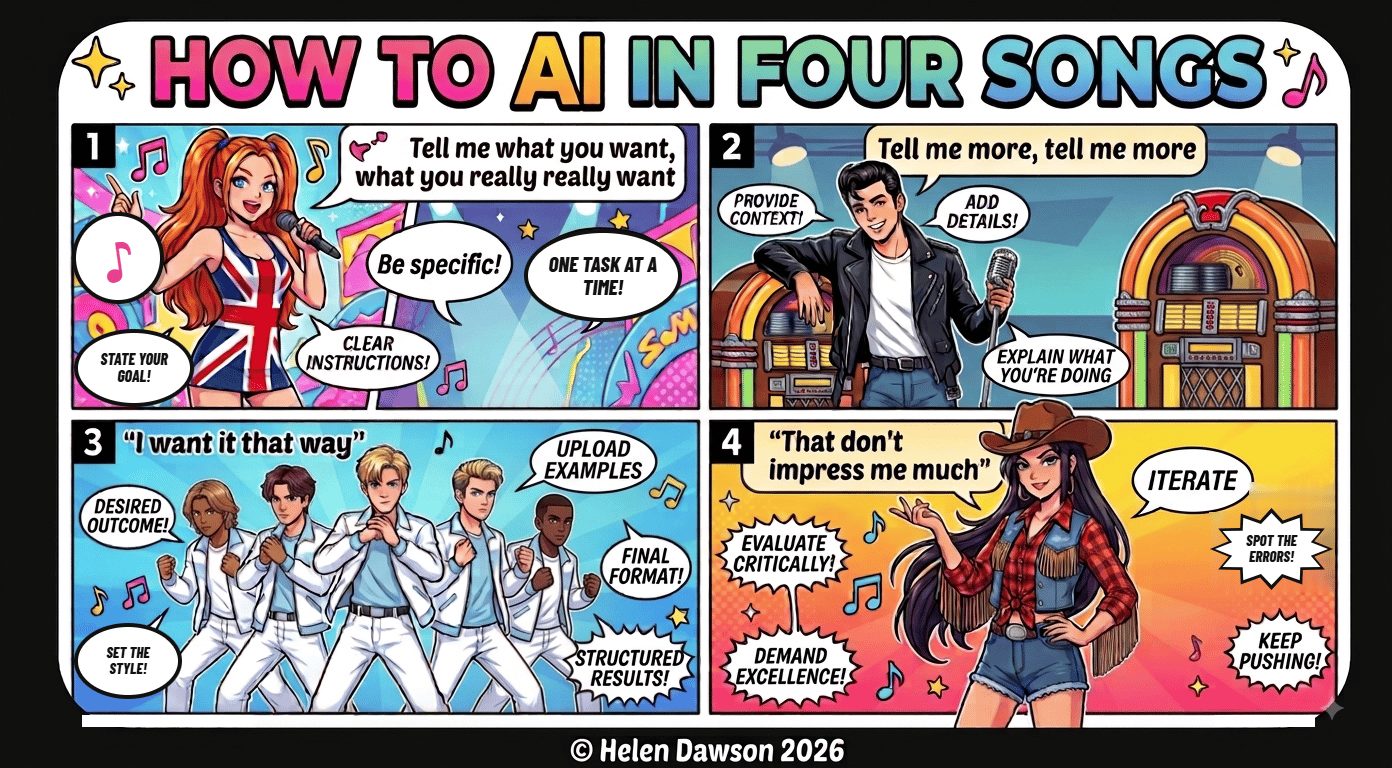
A great first step is building AI literacy in your organisation. So channelling that 1990s energy, here’s my how to AI in four songs, none of which are by the Stereophonics (sorry, Kelly Jones).
1. Spice Girls: tell it what you want, what you really, really want
Hat tip to Allie K Miller, who I heard say the first two.
Many of you will have heard about prompt engineering: how to write a prompt in a chatbot to get the best results, following various formulas like RTF. We then moved on to context engineering, which is: let’s write a set of documents that explain all of the context about our business, so the AI knows everything about your business and what it’s looking at.
It felt like you had to become some sort of black belt in systems thinking and precise wording of your interactions in order to get something useful out.
We’re now in a new era. The way that we interact with these tools has improved to the point that following these regimented approaches is no longer needed. You can talk in natural language, either spoken or typing.
This is a lot of what that prompt engineering vibe was about. What audience are you producing something for? What format do you want it in? What are you trying to achieve? What sort of experience do you want your tool to bring to the party? If you want a report, explain these are the headings. Use bullet points, or use numbering, or don’t write long sentences. You can describe that in prose, or you can say, “This is for an executive audience.”
Tell it what you want, what you really, really want. That’s the key thing to remember.
2. Grease: tell me more, tell me more
If at any point you don’t understand what your AI tool is doing, ask it questions and get it to explain things to you step by step. “Why are you doing it that way? What would it take to change this output?”
The questions go both ways. If you’re not quite sure what you want, or what all the elements are that it needs to know, get it to ask you questions. It’s very effective now to say, “Interview me.” Claude has a nice “ask me questions” tool built in that will ask you sequential questions. That’s how you give it all of that Spice Girls information.
3. Backstreet Boys: I want it that way
Hat tip to my friend Katie Skelton.
Here we’re talking about giving your AI tool examples of what good looks like. Rather than saying, “Don’t write emails like this,” or “I prefer it if you use short sentences,” you could provide your tone of voice guidelines. You could provide four or five examples of high-performing blog posts that capture your tone of voice and say, “This is what we want to see.”
Your brand guidelines, your standard PowerPoint template, your standard proposal template.
“Design me a website. Here are two examples of websites that I really, really love.” Give it screenshots.
Documents give the AI a filing cabinet. Screenshots give it eyes. Transcripts give it ears.
4. Shania Twain: That Don’t Impress Me Much
This one’s a Helen Dawson original.
What you want to do is iterate. I like these things, but we need to change this. Here’s some context that I didn’t give you. Can you pull that from this report? I’m not sure if this data is accurate. Can you validate every citation that you’ve given me before you return the next iteration?
Hints and tips to get the very best results
As these capabilities increase, the things that you might be checking today, you can ask your AI to spin up an agent to do some of those checks before you even receive it. For example,
• Check every item in this report has the appropriate alt text.
• Check that this meets these accessibility guidelines.
• Check this against my AI tropes list to remove any negative parallelisms and em dashes.
OK, Now What?
And putting that all together: if this is a task that you do a lot (for me, that might be editing podcasts), then I can say, “Right, let’s take everything we’ve worked on today and make a repeatable podcast skill so that I can do this again the next time.” The next time, you can say, “Okay, what do I need to change in this skill so that it accommodates the extra things we’ve thought of today?”
And when you’re happy, maybe you can connect to your studio tools to automate those steps every time you finish recording.
This is what we do on one of our innovation days: trying things with AI together as a team, with a coach every step of the way. I often badge it “prototypes by home time”.
So, if you think your team could benefit from an AI innovation day, you have budget and could carve out a day (two, even better) before the end of the year to roll your sleeves up and get building, email me and let’s talk.
Until next time,
Helen